Material handling is an important part of construction because large quantities of soil, aggregate, debris, and other materials often need to be moved throughout a project. The right loading equipment can make these activities more organized, particularly when materials must be transferred between different levels, vehicles, or working areas.
Choosing a loader should not be based on machine size alone. Reach, lifting capacity, operating space, attachment options, ground conditions, and the type of material being handled all contribute to whether a particular machine is suitable.
A thoughtful selection process can help avoid situations where equipment is either underpowered for the workload or unnecessarily large for the site.
Before looking at specific machinery, establish what the equipment will actually be expected to do.
Some projects primarily involve loading excavated soil into trucks. Others may require moving aggregate around a site, placing materials at a particular height, clearing debris, or supporting multiple construction activities.
The material itself matters too. Loose soil may be easier to handle than heavier or densely packed material, which can place greater demands on the machine.
Consider the volume of material, distance it needs to move, required loading height, and frequency of the operation. These details provide a clearer basis for selecting equipment.
Reach can become particularly important when material needs to be deposited beyond the machine's immediate position.
A loader with suitable reach can place material into trucks, stockpiles, or other locations without requiring constant repositioning. This can be useful on sites where movement is restricted or where loading points have a fixed position.
However, maximum reach should not be viewed separately from lifting capacity. A machine may have considerable reach but still have limitations when handling heavier loads at greater distances.
The intended working position should therefore be considered when reviewing equipment specifications.
Capacity determines how much material the machine can handle during a particular operation. Selecting equipment with insufficient capacity may slow the job, while choosing excessive capacity can increase rental and operating expenses without providing a practical benefit.
Bucket size is another relevant factor. A larger bucket can move more material per cycle, but it may not always be appropriate for the machine, material, or site conditions.
The type and density of the material should be considered before selecting a bucket configuration.
Productivity depends on more than the maximum figure listed in a specification sheet. The equipment must be able to perform consistently under the actual conditions found on the project.
The physical layout of a construction area can influence loading machinery as much as its capacity.
A spacious site may provide enough room for larger equipment to maneuver freely. A crowded project containing buildings, stored materials, temporary structures, and other machinery may require a more carefully selected configuration.
Turning space, access routes, ground conditions, and loading positions should be examined before equipment is delivered.
If trucks are being loaded regularly, consider where they will park and how the loader will approach them. A poorly organized loading area can create unnecessary waiting and movement even when the machinery itself is capable of performing the task.
Different construction activities may call for different machine configurations. Some jobs require straightforward loading capability, while others benefit from extended reach or additional versatility.
A machine equipped with the appropriate boom configuration can be useful where materials need to be positioned at greater distances or heights.
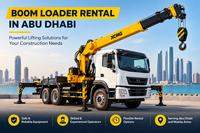
When reviewing Boom Loader Rental Abu Dhabi, the important question is not simply how far the boom extends. The complete working range should be compared with the site's loading points, material type, expected load, and available maneuvering area.
This broader assessment makes it easier to determine whether the equipment will genuinely support the intended operation.
Attachments can influence how effectively loading equipment performs different tasks.
Buckets are available in various designs and capacities, while forks and other tools may support material-handling activities beyond standard loading.
Before making a rental arrangement, prepare a list of the materials that will be moved and the tasks that must be completed. This information can help determine whether a standard bucket is adequate or another attachment would be more useful.
It is also important to verify attachment compatibility. The tool should be suitable for the machine's capacity and hydraulic system.
Selecting attachments according to actual requirements avoids paying for equipment that provides little practical value.
Loading machinery needs a suitable surface for safe and productive operation. Uneven, soft, muddy, or unstable ground can affect movement and machine positioning.
If trucks and loaders are working together, the loading area should provide enough stability for both pieces of equipment.
Ground preparation may therefore become part of the wider equipment plan.
Site conditions can also influence the type of machine selected. A configuration that works well on a prepared industrial surface may not be equally suitable for rough or uneven terrain.
Assessing the ground before rental helps ensure that the equipment matches the environment in which it will operate.
Loader productivity is closely connected to the availability of transport vehicles.
If trucks are not ready when the loader completes a cycle, the machine may spend time waiting. On the other hand, too many trucks arriving simultaneously can create congestion around the loading area.
A basic loading schedule can help coordinate vehicle arrival and departure times.
The distance between the excavation or stockpile area and the loading point should also be considered. Reducing unnecessary movement can improve the overall flow of materials.
Good coordination allows the loading machine and transport vehicles to function as part of the same process rather than as separate activities.
The financial side of equipment selection deserves attention before a booking is confirmed.
Daily rental charges are only one part of the total expense. Transportation, attachments, fuel, operating requirements, and possible rental extensions may also contribute to the final cost.
Estimate how long the machine will realistically be needed and compare the complete rental arrangement rather than focusing on one quoted figure.
If the equipment is required for several stages of the project, scheduling its use carefully may prevent paying for idle days.
A clear understanding of the rental terms also helps when the construction schedule changes unexpectedly.
Even suitable equipment can lose productivity if it is positioned poorly.
The loader should have enough space to approach material, maneuver, and reach the intended loading point. Trucks should be positioned where they can be loaded without creating unnecessary obstacles.
The working area should also remain clear of unrelated construction activities whenever possible.
A well-organized site layout can make the machine's existing capabilities more useful without requiring additional equipment.
Reach, capacity, attachments, site dimensions, ground conditions, and transportation all play a role in choosing loading machinery.
Instead of selecting equipment according to one specification, consider how all these factors interact during the actual operation. The ideal configuration for a spacious earthmoving site may be very different from what works on a confined construction project.
Careful planning also makes it easier to coordinate loaders with excavators, trucks, and other machinery.
When the selected equipment corresponds closely with the site's requirements, material handling can become more predictable and organized. A clear understanding of the workload and working environment provides a stronger foundation for arranging machinery that can perform efficiently throughout the required stage of construction.